GEOTECHNICAL ENGINEERING
COLUMBUS OHIO
HomeSeismicBase isolation seismic design

Base Isolation Seismic Design in Columbus Ohio | Site-Specific Ground Motion Analysis

Sound ground. Sound decisions.

LEARN MORE

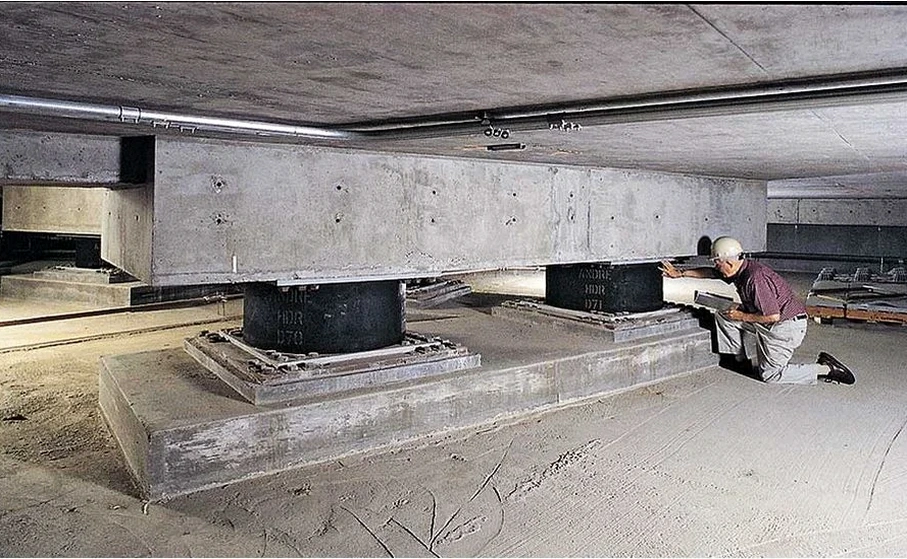
Specifying a friction pendulum system without verifying the near-surface shear wave velocity against the Ohio State Seismic Zone 1 design spectra is a recurring mistake in Columbus. ASCE 7-22 Section 17.3 requires a site-specific probabilistic seismic hazard analysis when Site Class D or E governs, which is common in the Scioto River valley. We see isolation periods tuned to generic 1.0-second spectral accelerations that miss the amplification peaks in the 0.2–0.5 s range produced by the local glacial till and lacustrine clay sequence. A geophysical campaign with MASW profiling to 30 meters resolves the Vs100 and Vs30 needed to classify the site correctly per IBC 2024 Table 1613.2.3, and the data feeds directly into the upper- and lower-bound isolator property definitions for the bounding analysis. Without this step, the design engineer is iterating on a target period that may not match the soil column response at the project coordinates — 39.3321°N, 84.3509°W.

A one-size isolation period tuned to ASCE 7 mapped values can miss the local amplification spike that the glacial till column produces between 0.3 and 0.6 seconds in Columbus.
Our service areas

Methodology and scope

Columbus sits on a complex glacial stratigraphy where the average depth to the carbonate bedrock ranges from 12 to over 40 meters depending on proximity to buried valleys. The upper 6 to 9 meters typically consist of Wisconsinan-age till with interbedded silt lenses, and the water table fluctuates between 1.5 and 3.5 meters below grade in the Olentangy and Scioto corridors. These conditions shift the spectral acceleration at short periods enough to push a Site Class C assumption into Site Class D territory, altering the mapped Sₘₛ and Sₘ₁ values. Our approach couples downhole seismic testing with resonant column data on undisturbed Shelby tube samples to build modulus reduction and damping curves specific to the formation. The laboratory operates under ISO/IEC 17025:2017 scope for triaxial and resonant column testing. When the project involves a tall or irregular superstructure, the isolator displacement demand must also account for near-fault pulse effects even at moderate magnitudes, and we support that analysis with a seismic microzonation study that refines the uniform hazard spectrum block-by-block. For retrofit projects where the existing foundation cannot be decoupled easily, a grouting program to stiffen the bearing stratum under the isolation plane is sometimes paired with the bearing replacement sequence.
Base Isolation Seismic Design in Columbus Ohio | Site-Specific Ground Motion Analysis
Technical reference — Columbus Ohio

Site-specific factors

Downtown Columbus expanded rapidly after the 1913 flood, when the Scioto River overwhelmed the low-lying warehousing district and prompted the first comprehensive levee system. Much of the Arena District and Franklinton sits on 3 to 6 meters of historic fill mixed with demolished foundations and river cobble, placed directly over soft lacustrine deposits. That fill profile creates a sharp impedance contrast that traps seismic energy in the upper layers — precisely the scenario where an isolation system designed without a site response model underestimates the spectral displacement demand. The 1980 Sharpsburg earthquake (mᵇ 5.2) produced Modified Mercalli Intensity V in Franklin County, and while Ohio seismicity is intraplate, the recurrence of M5+ events in the Anna Seismic Zone means a 2,475-year return period is the correct design basis for essential facilities under IBC 2024 Table 1604.5. A poor isolator characterization introduces residual drift that can lock sliding bearings against their moat walls. We mitigate this with three-dimensional nonlinear time-history models that incorporate the strain-softening behavior of the till, validated against the site-specific Vs profile.

Need a geotechnical assessment?

Reply within 24h.

Email: contact@geotechnicalengineering.biz

Applicable standards

ASCE/SEI 7‑22 Minimum Design Loads and Associated Criteria for Buildings and Other Structures, IBC 2024 Chapter 16 & 17, ASTM D4428 / D7400 Standard Test Methods for Crosshole and Downhole Seismic Testing, ISO/IEC 17025:2017 General requirements for the competence of testing and calibration laboratories, ASHRAE 171‑2023 Method of Test for Seismic Restraint Devices (isolator prototype testing)

Reference parameters

ParameterTypical value
Design spectral acceleration Sₛᵢ (Site Class D, 2475‑yr)0.18g – 0.32g per USGS NSHM 2023
Site coefficient Fᵥ (Class D, S₁ ≤ 0.1g)2.4 per ASCE 7‑22 Table 11.4‑2
Target isolation period Tᵥ (typical range)2.5 – 3.5 s for friction pendulum; 2.0 – 3.0 s for LRB
Maximum considered earthquake displacement Dₘ250 – 425 mm for MCEₙ spectra at Columbus coordinates
Near-surface Vs30 (Scioto corridor)180 – 260 m/s (Site Class D)
Bearing stratum undrained shear strength sᵤ75 – 150 kPa (glacial till, depth-dependent)
Allowable bearing pressure under isolation plane190 – 380 kPa (spread footing on competent till)
Moisture content variation (seasonal, upper 2 m)12% – 24%

Common questions

What is the typical design displacement for an isolation system on a Site Class D profile in Columbus?

For the 2,475‑year Maximum Considered Earthquake at a Site Class D location in the Scioto River valley, the design displacement Dₘ typically falls between 250 and 425 mm for a friction pendulum system with an effective period of 2.5 to 3.5 seconds. The exact value depends on the mapped S₁ and Sₛ from the USGS NSHM, the site amplification factors applied per ASCE 7‑22 Chapter 11, and the isolator characteristic strength normalized by the supported weight. Our analysis always runs both the deterministic lower‑bound and probabilistic upper‑bound spectra to bracket the displacement demand before finalizing the moat wall clearance.

How much does a base isolation design package cost for a building in Columbus?
Does the Ohio Building Code require nonlinear time‑history analysis for isolated structures?

Yes, for Risk Category III and IV structures, ASCE 7‑22 Section 17.5 mandates nonlinear response‑history analysis using a suite of at least 11 ground‑motion pairs that are spectrally matched to the site‑specific design spectra. For Risk Category II buildings, a simplified bounding analysis with upper‑ and lower‑bound isolator properties is permitted, provided the effective damping does not exceed 30% of critical and the isolation period remains below 4.0 seconds.

Location and service area

We serve projects across Columbus Ohio and surrounding areas.

View larger map