GEOTECHNICAL ENGINEERING
COLUMBUS OHIO
HomeGround improvementVibrocompaction design

Vibrocompaction Design in Columbus Ohio: Deep Compaction for Urban Infrastructure

Sound ground. Sound decisions.

LEARN MORE

Columbus grew fast along the Scioto and Olentangy river corridors, and a lot of that urban footprint sits on alluvial sands and silty floodplain deposits. Buildings put up in the 1970s and 1980s often relied on shallow footings over material that was never deeply densified. Today’s taller mixed-use projects and warehouse expansions demand a different approach. Vibrocompaction design gives engineers a way to improve loose granular soil in place without hauling off thousands of cubic yards. The vibroflot penetrates by water jetting and vibration, then the column is backfilled in lifts while the probe re-compacts the surrounding ground. When we run the job, we pair the design with field verification using CPT testing to confirm tip resistance gains and SPT drilling for blow count correlation before structural loads are applied.

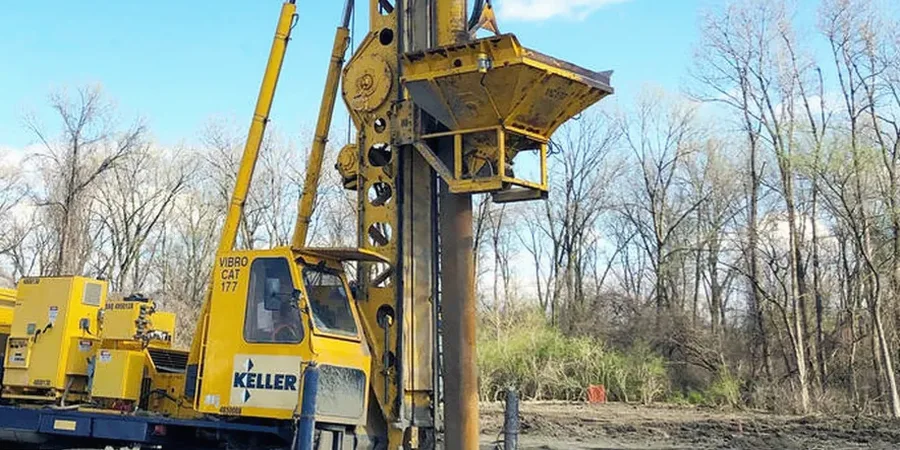
Vibrocompaction turns loose floodplain sand into a dense bearing stratum without excavation, using probe vibration and controlled backfill in a single pass.
Our service areas

Methodology and scope

The equipment we specify for Columbus jobs is typically an electric or hydraulic vibroflot with a 130–180 kW power pack, suspended from a crawler crane. The probe diameter runs 12 to 18 inches, and the eccentric weight inside spins at 1,800 rpm to generate horizontal vibratory force. Compaction points are laid out on a triangular grid – usually 6 to 10 feet spacing – based on the grain-size distribution of the native material. In the Scioto River deposits we often see clean fine to medium sand with less than 10 percent fines, which responds fast to vibration. The vibroflot advances under its own weight plus water flush, and once it hits refusal depth – typically 25 to 40 feet below grade in central Columbus – the operator starts building the stone column in 2-foot lifts while recording ammeter draw and lift time. For mixed fills with silt lenses we integrate stone columns as a complementary ground improvement method that drains and reinforces simultaneously.
Vibrocompaction Design in Columbus Ohio: Deep Compaction for Urban Infrastructure
Technical reference — Columbus Ohio

Site-specific factors

Central Ohio winters bring freeze-thaw cycles down to 30 inches, while spring rains push the Olentangy well above its banks and saturate the ground for weeks. A vibrocompaction design that ignores seasonal groundwater rise will leave loose lenses that settle differentially under load. The real risk is undercompaction in zones with perched water or thin silt seams that damp vibration energy transfer. Our design approach maps these layers from existing borings and adjusts point spacing locally rather than applying a uniform grid across the whole site. On the east side of Columbus, near the old limestone quarries, we also watch for solution cavities in the underlying bedrock that can channel vibration unpredictably. We verify every zone with post-treatment CPT soundings to confirm the design relative density was actually achieved before the structural engineer locks in foundation dimensions.

Need a geotechnical assessment?

Reply within 24h.

Email: contact@geotechnicalengineering.biz

Applicable standards

IBC Chapter 18 – Soils and Foundations, ASCE 7-22 – Seismic site class determination via SPT/CPT, ASTM D1586 – Standard Penetration Test, ASTM D2487 – Soil classification for granular material assessment, FHWA-NHI-16-072 – Ground Improvement Methods

Reference parameters

ParameterTypical value
Typical treatment depth in Columbus glacial outwash20–45 ft
Probe power range130–180 kW
Grid patternTriangular, 6–10 ft spacing
Target relative density post-treatment70–85% Dr
Applicable fines content<12–15% passing #200 sieve
Backfill gradationClean crushed stone, ¾–2 in
Quality control methodCPT before/after plus SPT verification

Common questions

What type of soil in Columbus responds best to vibrocompaction?

Clean granular soils with less than 12 to 15 percent passing the #200 sieve. The alluvial sands along the Scioto River and the glacial outwash deposits north of I-270 are ideal candidates. Silty sands can be treated but require closer point spacing and may need a stone column hybrid approach for drainage.

How long does a vibrocompaction job take on a typical Columbus commercial lot?

A two-acre site with 25-foot treatment depth and 8-foot triangular spacing usually runs five to seven working days for the compaction phase, plus two days for pre- and post-treatment CPT verification. Mobilization and demobilization of the crawler crane and power pack add two days on either end.

What is the cost range for vibrocompaction design and verification in Columbus Ohio?

Location and service area

We serve projects across Columbus Ohio and surrounding areas.

View larger map