GEOTECHNICAL ENGINEERING
COLUMBUS OHIO
HomeSlopes & WallsRetaining wall design

Retaining Wall Design in Columbus Ohio: Geotechnical & Structural Solutions

Sound ground. Sound decisions.

LEARN MORE

A mixed-use development off Olentangy River Road hit a snag last fall: a 14-foot grade change at the property line left no room for a conventional sloped embankment. The developer needed a cantilever wall designed, permitted, and ready for bid in three weeks. Columbus keeps pushing outward into areas with complex terrain shaped by Wisconsinan glaciation—rolling moraines, buried valleys, and shallow shale. A retaining wall here is not a catalog item. Wall type selection, drainage design, and bearing verification against glacial till or weathered bedrock demand analysis specific to the site. We pair geotechnical investigation with structural wall design under IBC Chapter 18 and ASCE 7 load combinations. Before finalizing wall dimensions, we often verify subsurface conditions with SPT drilling to confirm refusal depth and assess the passive zone in front of the wall stem.

Columbus glacial till demands a drainage-first design philosophy—hydrostatic pressure behind the wall causes more failures than inadequate reinforcement.
Our service areas

Methodology and scope

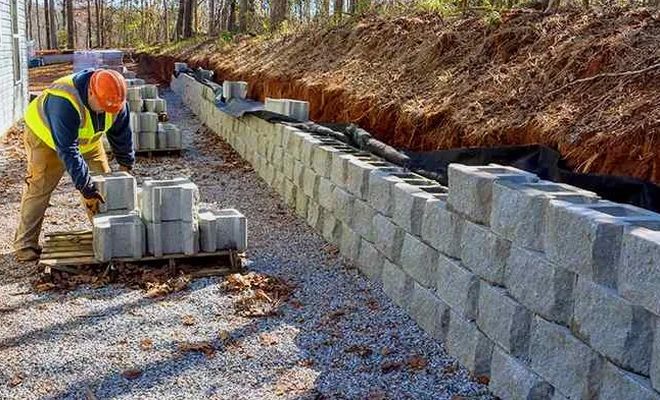
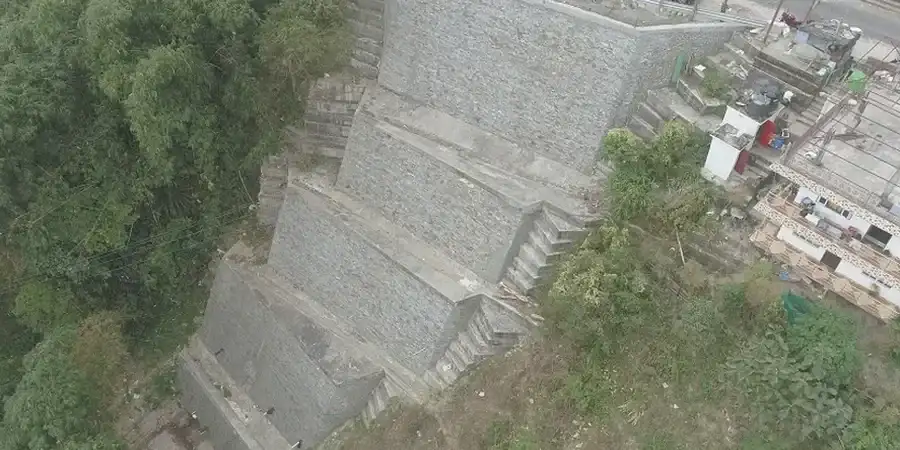
The difference between a wall in Dublin and one in Franklinton is the difference between stiff clay till and soft alluvial deposits along the Scioto River. Dublin sites typically sit on high-plasticity glacial till with good bearing capacity but significant swell potential during wet seasons. Franklinton soils, by contrast, are often layered silts and loose sands with groundwater within 6 to 8 feet of grade. These contrasts drive every design decision: heel width, key depth, backfill specification, and underdrain configuration. We design cast-in-place cantilever walls, segmental block MSE systems, and soil-nailed walls for tight urban excavations. For taller walls exceeding 12 feet or supporting surcharge from adjacent structures, we frequently incorporate tiered configurations with bench drains. A typical scope includes global stability analysis using limit equilibrium methods, bearing capacity verification per AASHTO LRFD, sliding and overturning checks, and finite element modeling for complex geometries with nearby foundations. All designs account for the seasonal freeze-thaw cycles that add lateral pressure to the upper stem during January and February.
Retaining Wall Design in Columbus Ohio: Geotechnical & Structural Solutions
Technical reference — Columbus Ohio

Site-specific factors

Columbus sits in a moderate seismic zone—USGS mapped spectral accelerations of 0.15 to 0.22g at 0.2-second period for the metropolitan area—but the bigger daily risk is hydrostatic loading from poorly drained backfill. We see walls in Clintonville and Upper Arlington with outward tilt after just two winters because the underdrain clogged or was omitted entirely. Ohio Shale bedrock, encountered at depths of 8 to 25 feet across much of Franklin County, introduces another variable: the weathered upper zone expands when exposed to air and moisture during excavation, degrading bearing capacity within hours. Our design approach mitigates these risks through mandatory subdrainage details, careful specification of backfill gradation per ODOT Item 703, and protective foundation treatment protocols when shale is exposed in the footing zone. For walls retaining slopes steeper than 2H:1V, we run transient seepage analyses to model pore pressure buildup during spring thaw.

Need a geotechnical assessment?

Reply within 24h.

Email: contact@geotechnicalengineering.biz

Applicable standards

IBC 2021 Chapter 18 (Soils and Foundations), ASCE 7-22 Section 11.8 (Seismic Earth Pressure), AASHTO LRFD Bridge Design Specifications 9th Edition, ODOT Bridge Design Manual, ASTM D6913 (Particle-Size Analysis of Backfill)

Reference parameters

ParameterTypical value
Design codeIBC 2021, AASHTO LRFD 9th Ed.
Wall types designedCantilever, MSE, soil nail, gravity, anchored
Max. retained height30 ft (taller with tiered configuration)
Backfill specificationODOT 703 free-draining granular
Global stability methodSpencer limit equilibrium, minimum FoS 1.5
Seismic coefficientSs = 0.15–0.22 per USGS Columbus grid
Drainage requirementContinuous underdrain + weep holes at 8 ft o.c.
Typical bearing materialGlacial till, weathered Ohio Shale

Common questions

How much does retaining wall design cost in Columbus?
Do I need a building permit for a retaining wall in Columbus?

Yes. The City of Columbus Building and Zoning Services requires a permit for any retaining wall over 4 feet in height, or any wall supporting a surcharge such as a driveway or structure. The permit submittal must include sealed structural calculations and a geotechnical report addressing bearing capacity and global stability.

What backfill material is required behind a retaining wall in Franklin County?

We specify ODOT Item 703 free-draining granular backfill for all retaining walls in the Columbus area. This material—crushed stone or gravel with less than 5 percent passing the No. 200 sieve—prevents hydrostatic pressure buildup and reduces lateral earth pressure on the wall stem.

How long does the design and approval process take?

A typical design package for a standard cantilever wall takes 10 to 14 business days from receipt of complete geotechnical data. Complex walls involving MSE or soil nail systems may require 3 to 4 weeks. City permit review adds approximately 2 to 3 weeks depending on current workload at Building and Zoning Services.

Location and service area

We serve projects across Columbus Ohio and surrounding areas.

View larger map