GEOTECHNICAL ENGINEERING
COLUMBUS OHIO
HomeLaboratoryTriaxial test

Triaxial Testing in Columbus Ohio for Foundation Design and Slope Stability

Sound ground. Sound decisions.

LEARN MORE

The soil profile in Columbus shifts dramatically between the Scioto River floodplain in Franklinton and the carbonate bedrock ridges of Upper Arlington, creating very different demands on foundation engineering. A shallow spread footing on the dense glacial till of the northwest side behaves nothing like one bearing on the compressible alluvium near downtown. The triaxial test becomes essential equipment for quantifying this variability—it isolates the shear strength parameters c' and φ' under controlled drainage conditions that simpler index tests cannot replicate. While a standard penetration test provides a useful preliminary profile, the triaxial cell delivers the constitutive parameters required for finite element modeling of complex excavations or retaining structures. Our laboratory processes undisturbed Shelby tube samples from across Franklin County, applying confining pressures that match the overburden stress at the intended foundation depth.

A single triaxial test on an undisturbed sample provides more actionable design parameters than a full program of index tests alone.
Our service areas

Methodology and scope

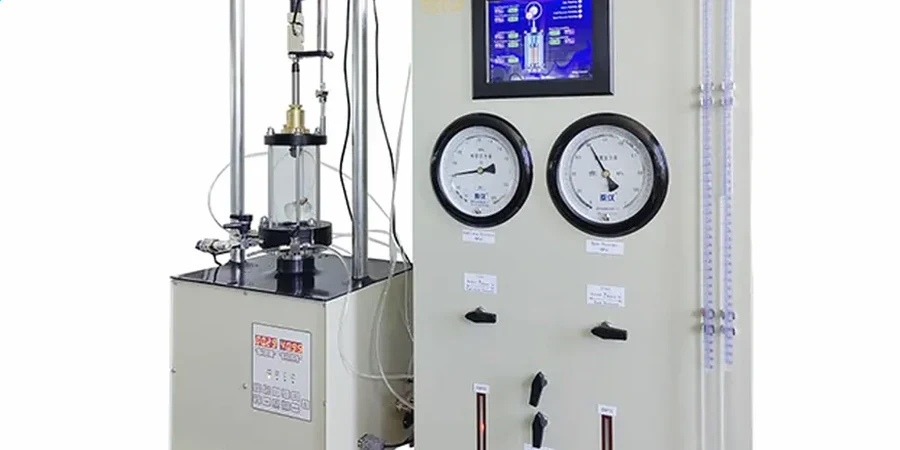
The triaxial cell installed in the laboratory operates with a closed-loop digital pressure-volume controller that maintains confining stress within ±1 kPa of the target value throughout the shearing stage. For Columbus projects, where the lodgement till contains occasional cobbles and the shale can be highly fissile, careful specimen preparation is the step that determines data reliability. The membrane is inspected under a backlight for pinholes before mounting, and filter-paper side drains are trimmed to avoid creating preferential flow paths. During the consolidation phase of a consolidated-undrained test, the pore pressure transducer records the B-value; a minimum of 0.95 is required before shear initiation to confirm full saturation. The axial loading rate is then set according to the time-to-failure derived from consolidation data, typically 0.5 to 2% strain per hour for the low-permeability glacial lake clays found east of the Scioto. When the project involves cut slopes in weathered shale, the triaxial test is paired with a slope stability analysis to model the effect of pore pressure rise during spring thaw conditions.
Triaxial Testing in Columbus Ohio for Foundation Design and Slope Stability
Technical reference — Columbus Ohio

Site-specific factors

The glacial stratigraphy beneath Columbus includes interbedded layers of sand, silt, and lean clay deposited by multiple Wisconsinan ice advances, meaning a single borehole can encounter materials with drained strengths exceeding 38 degrees friction angle directly above normally consolidated clays with undrained shear strengths below 30 kPa. Designing a retaining wall or deep excavation without triaxial data for these clay seams invites basal heave failure during the construction dewatering phase. In the Scioto River corridor, the water table sits within 2 to 4 meters of grade from March through June, and the reduction in effective stress during a rapid drawdown event can destabilize slopes that appeared stable under steady-state seepage conditions. Triaxial testing quantifies this risk by measuring the rate of excess pore pressure generation during undrained loading, providing the input needed to specify dewatering pump capacity and to establish trigger levels for the excavation monitoring plan.

Need a geotechnical assessment?

Reply within 24h.

Email: contact@geotechnicalengineering.biz

Applicable standards

ASTM D4767-11: Standard Test Method for Consolidated Undrained Triaxial Compression Test for Cohesive Soils, ASTM D2850-15: Standard Test Method for Unconsolidated-Undrained Triaxial Compression Test on Cohesive Soils, ASTM D4220 / D4220M-14: Standard Practices for Preserving and Transporting Soil Samples

Reference parameters

ParameterTypical value
Test standard (CU with pore pressure measurement)ASTM D4767-11
Test standard (unconsolidated-undrained)ASTM D2850-15
Specimen diameter36, 50, 70 mm
Confining pressure range50 to 1,500 kPa
Saturation check (B-value)≥ 0.95
Typical shearing rate0.5 to 2% strain per hour
Data deliverablesMohr-Coulomb envelope, p-q diagram, stress-strain curves

Common questions

What is the typical cost for a triaxial test program on a Columbus project?
How long does it take to receive the triaxial test results once the samples are delivered to the lab?

For a standard CU triaxial suite on cohesive soil from Columbus, the consolidation and shearing stages typically require between 10 and 14 working days. The duration depends on the hydraulic conductivity of the material; siltier samples drain faster and shear sooner, while lean clays may require a week of consolidation per specimen. A complete report with Mohr-Coulomb parameters and stress-strain plots is issued within three weeks.

What sample quality is required for triaxial testing and how should samples be handled on site?

Undisturbed samples are required, typically obtained with a thin-walled Shelby tube pushed hydraulically in accordance with ASTM D1587. The tubes must be sealed immediately after extraction with wax or plastic caps, kept upright, and transported without vibration or temperature extremes. Samples that have been frozen, dried out, or visibly disturbed cannot yield reliable triaxial data. For the shale and till encountered in central Ohio, keeping the tube length under 600 mm reduces the risk of sample damage during extraction.

Location and service area

We serve projects across Columbus Ohio and surrounding areas.

View larger map